


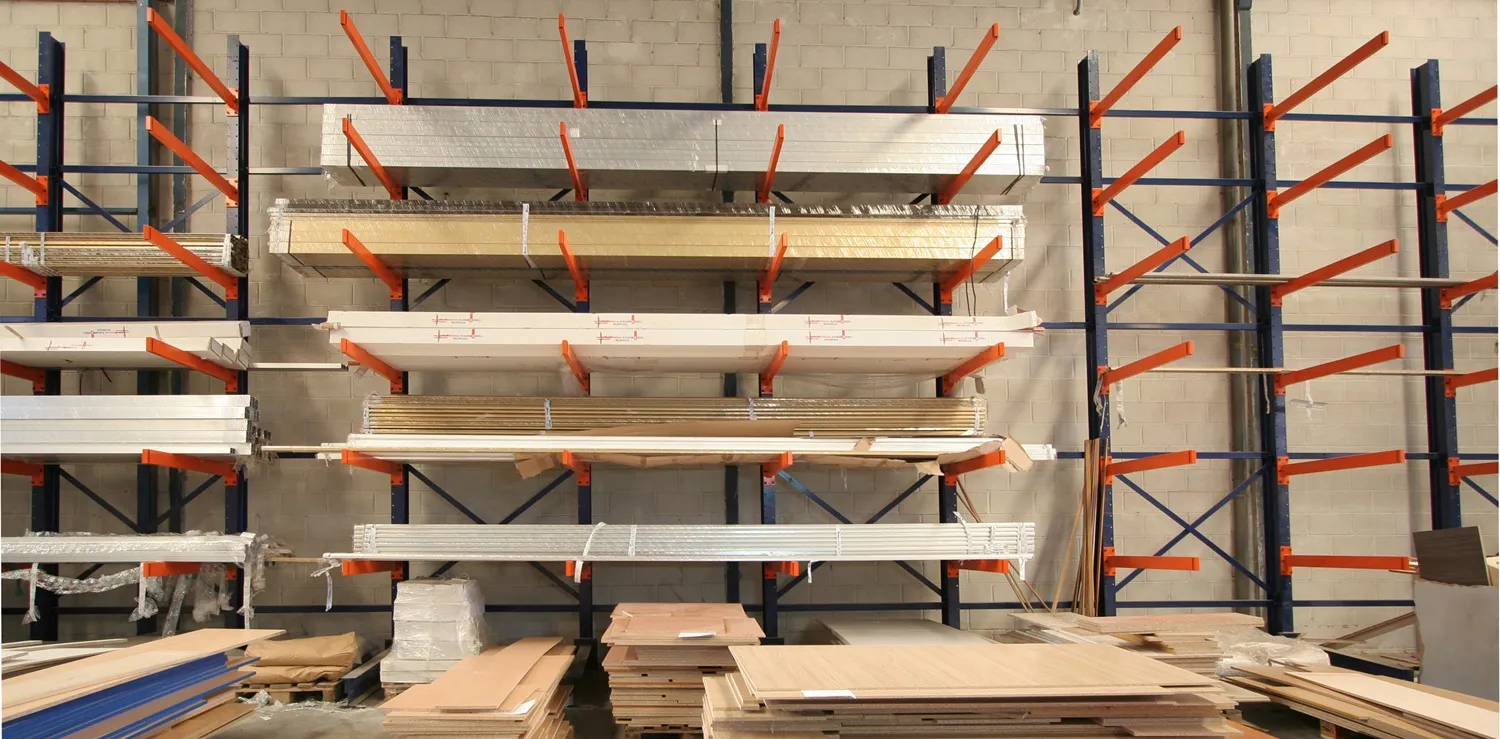
Cantilever racking is a type of racking system designed without front uprights for storing long and bulky goods. What you need to know:
- There are two basic configurations: single (access from one side, wall-mounted) and double (access from both sides, freestanding).
- They are the only efficient solution for storing pipes, metal sections, wooden panels or furniture.
- They allow direct forklift access to any loading level without any length restrictions.
What is a cantilever racking system and the origin of the term
The term ‘cantilever’ originates from Anglo-Saxon engineering and architecture, and translates into Spanish as ‘voladizo’. In the logistics sector, a cantilever racking system is a storage system consisting of rows of columns braced vertically by bolted trusses. Horizontal beams are positioned on top of these columns to support the goods.
Its design completely eliminates the vertical uprights at the front of the structure. It is precisely this absence of front obstructions that makes it possible to handle exceptionally long load units that would not fit into a traditional palletising system.
How the cantilever arm system works
This system works by transferring the weight from the arms to the columns, which are in turn stabilised by bases that are firmly anchored to the floor.
The goods rest on the arms, and the forklift can load or unload the material with complete freedom of movement, ensuring load security and operational efficiency.
Types of cantilever racking: single and double
Depending on the warehouse layout and workflow, the cantilever system is available in two main configurations:
- Single-sided cantilever: The cantilever arms extend from just one side of the column. They are usually installed against the building’s perimeter walls, making the most of the building’s perimeter.
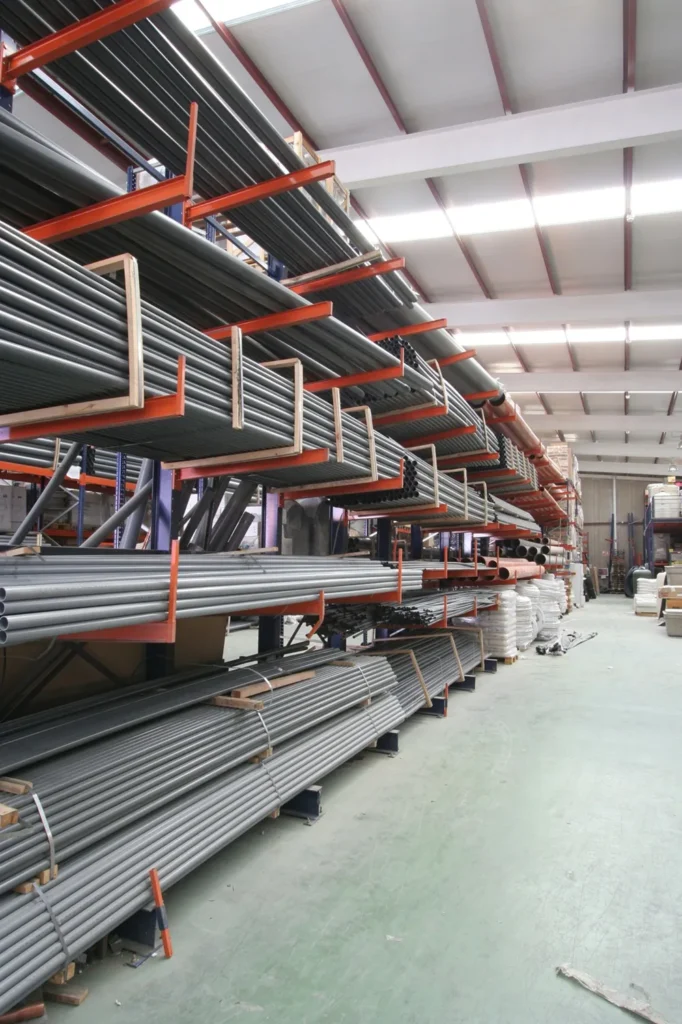
- Double cantilever (two-sided): The arms extend outwards on both sides of the central column. This structure forms a central island within the warehouse, allowing for forklift access from two parallel aisles, thereby doubling the storage capacity per column.
In terms of load-bearing capacity, both configurations can be adapted for light loads (aluminium profiles, plastic pipes), medium loads (wooden panels, furniture) or heavy industrial loads (steel beams, coils).
Comparison: cantilever racking versus conventional shelving
The choice between one system and another depends entirely on the shape of the load.
| Feature | Cantilever racking | Conventional racking (Pallet racking) |
| Ideal load type | Long, uneven and voluminous | Standardised pallets (Euro pallets) |
| Front pillars | They do not exist | Yes, they define the boundaries of each module |
| Length limit | None (continuous load) | Limited to the width of the stringer |
| Manipulation | Front-loading / reach truck | Front-loading / reach truck |
| Stock turnover | Sign up (direct access) | Sign up (direct access) |
How to calculate dimensions and load capacities
Correctly sizing a cantilever racking system requires precision engineering. The following factors are taken into account when calculating the structure:
- The height of the column: Determined by the clear height of the warehouse and the reach of the forklift.
- La longitud de los brazos: Debe ser igual o ligeramente superior a la profundidad de la carga. Nunca la mercancía debe sobresalir frontalmente del brazo.
- The spacing between columns: This is calculated based on the total length of the product and its flexibility (deflection), ensuring that the material does not bend under its own weight.
Cantilever racking products from Record
At Estanterías Record, we design and manufacture cantilever racking systems tailored to any industrial requirement. Our structures are manufactured from high-strength structural steel, incorporating safety stops at the ends of the arms to prevent cylindrical parts from rolling off accidentally. Furthermore, we offer epoxy paint finishes for indoor use and hot-dip galvanising for outdoor installations (provided they are under cover).
Installation guide and safety regulations
The installation process for this type of shelving is highly specialised and must comply with strict standards, such as UNE-EN 15620 or FEM 10.2.09, to ensure that the columns are perfectly vertical and that the bases are correctly anchored to the floor.
Frequently Asked Questions (FAQs) about the cantilever system
The system is designed for long goods such as metal bars, PVC pipes, aluminium extrusions, steel sections, wooden planks, slats and bulky furniture (such as sofas or beds).
Yes. It is very common in building supply stores or sawmills to design cantilever racking in such a way that the columns themselves support a roof, creating an outdoor storage area sheltered from the rain, which is usually galvanised.
The Cantilever is designed to support very heavy loads, ranging from tonnes per arm to full industrial capacities. The exact capacity depends on the structure’s design, the length of the arms and the distance between the struts. It is always advisable to check the rated load capacity for each arm and column.
Yes, because the arms are secured to the column using a bolted system, allowing the height between levels to be adjusted to meet the warehouse’s future needs.
Manual or electric pallet trucks can be used for handling goods on the lower levels, whilst stackers, counterbalanced forklifts, reach trucks and three-way forklifts can be used for the upper levels. It is essential to know what goods will be handled and what type of material-handling equipment will be used.
Of course. Like all industrial storage systems, cantilever racking is subject to European regulations and must undergo an annual Technical Racking Inspection (ITE) to check for tightness, deformation and the condition of the fixings.
Do you need to store long loads safely and make the most of your space?
At Estanterías Record, we manufacture bespoke cantilever racking systems. Our engineering team will assess the dimensions of your warehouse and the type of load to provide you with the most efficient solution.
Request a no-obligation quoteWould you prefer to look at the specifications first? Download our technical catalogue.